
RTP Without the Jargon
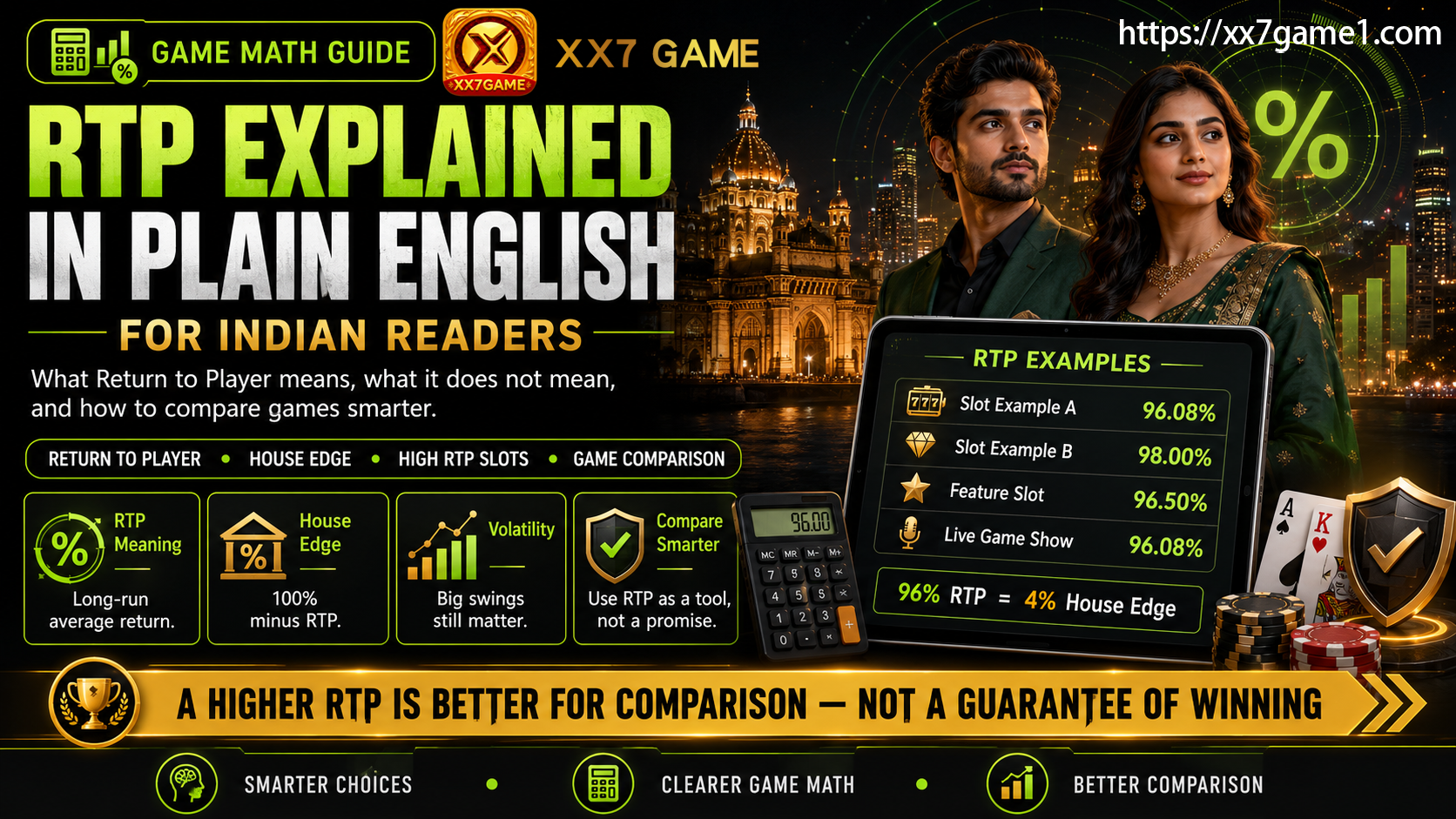
RTP is short for Return to Player. The number describes how much of all money wagered a game is designed to return across an enormous sample of rounds. It says something useful about the game model, but almost nothing about what will happen to one person tonight. Think of RTP as a long-term comparison figure—not a payout promise, a forecast or a playing system.
Turning RTP into House Edge
Subtract the RTP from 100% and you have the built-in house edge. A slot listed at 96% RTP therefore carries a 4% theoretical operator advantage. A higher RTP generally means a smaller edge over the long run, but it still cannot make a chance-based game safe or reliably profitable.
- 95% RTP leaves a 5% house edge
- 96% RTP leaves a 4% house edge
- 98% RTP leaves a 2% house edge
Why ₹1,000 Does Not Simply Return ₹960
The 96% figure does not mean that a ₹1,000 session should end with ₹960. Over a short stretch, variance dominates the result. One player might lose the balance before seeing a feature, while another lands a bonus in the opening rounds. Both outcomes can occur in a game whose theoretical RTP is identical.
Return and Volatility Answer Different Questions
RTP concerns the proportion returned over a very long period. Volatility describes the pattern in which wins and losses tend to arrive. Two slots with similar RTP can feel unrelated: one produces smaller wins fairly often, while the other has longer quiet spells broken by much larger swings.
Other Details Worth Opening the Info Screen For
- How often winning combinations appear
- Bonus mechanics and the advertised maximum win
- Rules for tables or game-show features
- The RTP published inside the version you are actually playing
- Whether the provider offers more than one RTP setting for that title
The Myths the Percentage Cannot Support
A run of losing spins does not make the next one due to pay. A bonus round cannot beat the RTP because its returns are already included in the model. In the same way, choosing a game with a higher percentage may improve the long-term comparison, but it never guarantees a profit for an individual player.
Using RTP Responsibly
For Indian readers, the sensible use of RTP is educational. It can help compare two game versions, but it does not remove financial exposure, local legal questions or the randomness behind every round. Set limits on the assumption that the whole playing balance can be lost.
RTP Questions Players Ask Most
1. What does RTP stand for? Return to Player—the theoretical percentage returned across a very large number of rounds.
2. Is volatility another name for RTP? No. RTP concerns long-run return; volatility describes the size and spacing of swings.
3. Does a high RTP promise a win? No. The figure is not a personal payout guarantee.
4. Can one title have several RTP settings? Yes. Confirm the value inside the game information panel.
5. Is RTP a strategy? No. Use it to compare games, not to predict the next result.